Chardonnay is the soul, the heart and the breath of the estate.
Le Mesnil-sur-Oger is central to the identity of Domaine André Robert. In this Grand Cru village of the Côte des Blancs, our Chardonnay finds one of its most precise expressions: a combination of chalk, tension, salinity, freshness, depth and austere subtlety.
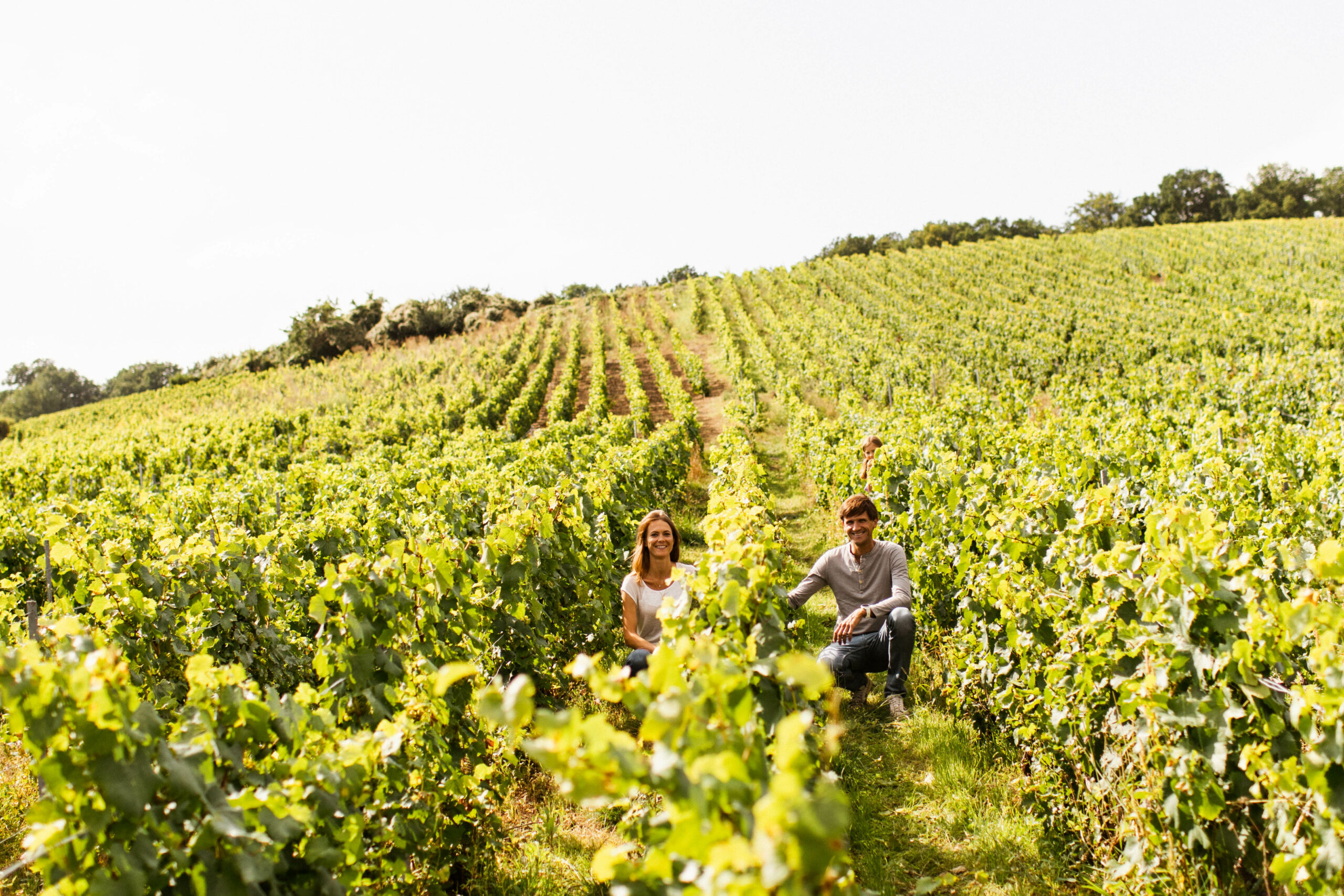
For us, Le Mesnil is not only a prestigious name in Champagne. It is a terroir we work every day, parcel after parcel, row after row, vine after vine. Each lieu-dit has its own rhythm, its own behaviour, its own way of ripening, retaining water and moving through dry or wet years. Together, they offer us a remarkable diversity of Chardonnay expressions.
Our work as winegrowers is to understand these nuances. A Chardonnay from Le Mesnil cannot be reduced to a general idea of minerality. It is born from a soil, a slope, an exposure, the age of the vines, the harvest date and the precision of the final blend.
A Grand Cru of the Côte des Blancs
Le Mesnil-sur-Oger belongs to the Côte des Blancs, one of Champagne’s historic heartlands for Chardonnay. The village is classified as Grand Cru, like Oger, Avize, Cramant and Chouilly, yet it has a very distinctive personality.
The wines of Le Mesnil are often known for their straightness, tension, chalk-driven expression and ageing potential. They do not necessarily seek immediate breadth. Their strength lies elsewhere: in precision, depth, limestone vibration and length on the palate.
At Domaine André Robert, this identity from Le Mesnil is central. It gives birth to several major expressions of the estate, including Les Jardins du Mesnil, a cuvée exclusively from the terroirs of Le Mesnil-sur-Oger, and Terre du Mesnil, a more selective vintage interpretation of the heart of this Grand Cru.
The chalk of Le Mesnil-sur-Oger: a soil that regulates the vine
Chalk is the geological foundation of Le Mesnil-sur-Oger. It is not merely a backdrop or a tasting word. It is an active element in the life of the vine.
Highly porous, chalk can absorb water during wet periods and release it gradually when the season becomes drier. This capacity for water regulation is essential for Chardonnay. It allows the vine to continue ripening without sudden stress, while preserving an important natural acidity.
In the wines, this chalk creates a very particular sensation: a straight, tense, spicy and saline palate, with a long and precise finish. The minerality of Le Mesnil is not only aromatic. It is felt in the texture, in the way the wine stretches and persists.
It is this relationship between the vine, the chalk and the climate that gives the Champagnes of Le Mesnil-sur-Oger their recognisable character.
A more complex pedology than simply “chalky soil”
Speaking about chalk is not enough. In Le Mesnil-sur-Oger, the soils change according to their position on the slope. The magic of a Grand Cru village lies there: not all lieux-dits are equal. It is the knowledge of the strengths and weaknesses of each parcel that allows the miracle to happen.
On some upper slopes, the soils are thinner, highly calcareous, with chalk close to the surface. These sectors produce very straight Chardonnays, more incisive and sometimes more closed in their youth, but with great ageing potential.
On the mid-slopes, the soils combine chalk with finer elements: limestone fragments, slope silts and sometimes a slight clay-silt component. These are often the most balanced areas. They produce complete wines, at once tense, deep and persistent.
At the bottom of the slope, or in lower-lying areas, the soils are generally deeper, with more colluvial deposits and a more regular water supply. These parcels bring fruit, body and acidity into the blends.
This pedological diversity is fundamental. It allows us to compose wines that are not only tense or mineral, but complete, alive and balanced.
The climate of Le Mesnil-sur-Oger: freshness, rainfall and slow ripening
Le Mesnil-sur-Oger benefits from a temperate Champagne climate, with regular rainfall and moderate temperatures. This cool climate is decisive in shaping the style of the wines.
The vine ripens slowly here. Chardonnay preserves its acidity, gradually develops its aromas and builds its structure without moving too quickly towards heaviness. This slowness is precious, because it allows us to seek full maturity without losing the natural tension of the terroir.
Rain also plays a major role. In winter, it recharges the soils and the chalk. In spring, it supports growth but can increase disease pressure, especially mildew. In summer, the water reserve held by the chalk helps the vine move through drier periods. In September, each rainfall episode can influence sanitary condition, concentration and the harvest date.
The harvest date in Le Mesnil-sur-Oger is often decided at the last moment. It requires careful observation: tasting the berries, monitoring the sugar-acidity balance, pH, sanitary condition, aromatic maturity and the behaviour of each lieu-dit.
Average rainfall in Le Mesnil-sur-Oger: a viticultural reading month by month
General climate data indicates annual rainfall of around 760 to 770 mm around Le Mesnil-sur-Oger. This figure should be read as a broad climatic average, not as a precise parcel-by-parcel measurement. At the estate, what matters is not only the annual quantity of water, but how it is distributed throughout the year.
| Month | Viticultural reading for Chardonnay in Le Mesnil |
|---|---|
| January | Winter recharge of the soils and chalk. An essential period for building deep water reserves. |
| February | Dormant season. Rain contributes to recharge, while soils remain cold. |
| March | Transition towards budbreak. Soil bearing capacity becomes important for the first vineyard work. |
| April | Budbreak. Rain can support growth, but the vine becomes more sensitive. |
| May | Strong vegetative growth. Mildew pressure can rise quickly depending on conditions. |
| June | Flowering and fruit set depending on the vintage. Rain can influence coulure, millerandage and yield. |
| July | Berry growth. Canopy and vigour management remain decisive. |
| August | Progressive ripening. The chalk plays its role as a water reserve and helps preserve acidity. |
| September | The decisive harvest month. Each rainfall event can change the balance between maturity, sanitary condition and concentration. |
| October | Return of autumn rains. Gradual replenishment of reserves after harvest. |
| November | Deep soil recharge. An important period for the water balance of the following year. |
| December | Complete vine dormancy. Winter rains feed the chalk reserves. |
This climatic reading explains part of the style of Le Mesnil wines: Chardonnays that preserve freshness, acidic energy and precision, even when vintages become sunnier.
Harvest dates in Le Mesnil-sur-Oger
Harvest dates in Le Mesnil-sur-Oger vary greatly from one vintage to another. They depend on the climate of the year, the earliness of the growing cycle, disease pressure, crop load and the objective sought for each cuvée.
Official harvest opening dates are set by village and by grape variety. They provide a regulatory framework, but they do not replace the winegrower’s decision. At Domaine André Robert, the actual picking date is refined through berry tasting and careful observation of the parcels.
The lower slopes are often harvested in the middle of the picking cycle, when the right technological maturity has been reached, with fruit and biting acidity. An upper slope may require more patience to reach full aromatic maturity, when it does. The heart of the terroir is always the earliest. Yet our old vines can retain strong acidity while developing great depth on the palate and almost complete phenolic maturity: the winegrower’s grail.
Harvesting in Le Mesnil is therefore a decision of balance. Picking too early can produce wines that are lean, hard or too strict. Picking too late can reduce tension, weigh down the fruit and weaken the chalky vibration. The aim is to find the right point: the moment when Chardonnay expresses maturity, freshness, salinity and length at the same time.
Easy? No.
The lieux-dits of Domaine André Robert in Le Mesnil-sur-Oger
Domaine André Robert works a mosaic of lieux-dits in Le Mesnil-sur-Oger. This diversity is essential, because it allows us to build a complete expression of the Grand Cru.
Among the lieux-dits cultivated by the estate are:
Aillerand, Au Dessus d’Aillerand, Chétillon de Haut, La Haie de Châlons Ouest, Le Bas de Zalieux, Le Champ d’Allouette, Le Pré, Les Bas Montpetins, Les Boulangères, Les Coullemets, Les Coullemets du Midi, Les Finciarts, Les Gaumes, Les Hautes Mottes Ouest, Les Hautes Voies, Les Mournouards, Les Mussettes, Les Playons, Les Varnaults Tend Cul, Les Volibarts de Haut, Pudepeigne and Vaucherot.
These names are not merely cadastral references. They are working identities. Each lieu-dit has its own behaviour: earliness, vigour, soil depth, water reserve, aromatic maturity, acidity, texture and possible role in the cuvées.
The lower slopes: fruit, volume and regularity
The lower sectors of Le Mesnil, such as La Haie de Châlons Ouest, Le Bas de Zalieux, Le Pré, Les Coullemets and Les Hautes Mottes Ouest, often bring Chardonnays that are more accessible in their youth.
The soils are generally deeper. The vine benefits from a regular water supply, which can bring more fruit, flesh and volume. These parcels are precious for balancing the stricter and more vertical expressions of Le Mesnil.
In the wines, they can bring notes of ripe apple, fresh pear, soft citrus and white flowers. Their role in the blend is important: they provide foundation, continuity and a measured form of generosity.
The mid-slopes: the heart of balance in Le Mesnil
The mid-slopes are often the most complete sectors of Le Mesnil-sur-Oger. At the estate, they include Aillerand, Au Dessus d’Aillerand, Chétillon de Haut, Le Champ d’Allouette, Les Coullemets, Les Coullemets du Midi, Les Finciarts, Les Mussettes, Les Playons, Les Varnaults Tend Cul, Pudepeigne and Vaucherot.
These parcels benefit from a natural balance between drainage, chalk depth, exposure and water reserve. They produce Chardonnays that are both tense and structured, with a fine relationship between acidity, maturity and substance.
Old vines play a major role here. On lieux-dits such as Les Coullemets du Midi, Les Coullemets and Les Varnaults Tend Cul, older roots explore the soil more deeply. The wines gain density, salinity and length. Power remains contained, but depth increases.
These mid-slopes form an essential part of the estate’s identity in Le Mesnil.
The upper slopes: tension, verticality and ageing potential
The upper slopes, such as Les Boulangères, Les Hautes Voies, Les Mournouards and Les Volibarts de Haut, produce more tense and vertical expressions of Chardonnay.
The soils are often thinner and more calcareous, with chalk closer to the surface. Ripening can be slower. Acidity remains strong. Wines from these sectors may seem more closed in their youth, but they possess an architecture that is very important for cuvées built for ageing.
In the blends, these parcels bring the backbone: tension, salinity, length on the palate, precision and ageing capacity. They are essential for preserving the noblest signature of Le Mesnil-sur-Oger.
Les Jardins du Mesnil: a complete reading of the terroir
Les Jardins du Mesnil is the cuvée that expresses the internal diversity of Le Mesnil-sur-Oger at Domaine André Robert. It comes exclusively from the terroirs of Le Mesnil. Its aim is not to isolate a single lieu-dit, but to compose a complete vision of the village.
The lower sectors bring fruit and volume. The mid-slopes give depth and balance. The upper slopes build tension, salinity and length on the palate.
This cuvée is conceived as a landscape of Le Mesnil. It brings together several expressions of Grand Cru Chardonnay to translate the complexity of the village: chalk, freshness, flesh, energy, precision and persistence.
Terre du Mesnil: a more selective vintage expression
Terre du Mesnil offers a more selective and vintage interpretation of Grand Cru Chardonnay from Le Mesnil-sur-Oger. It draws on the deepest balances of the terroir, with a search for substance, structure and ageing potential.
Ageing in oak barrels accompanies this expression without seeking to mask the chalk. It works on texture, complexity and depth while preserving the natural tension of Le Mesnil.
Terre du Mesnil is not a Champagne of immediate breadth. It is a cuvée of construction, patience and length, faithful to the spirit of the Grand Cru.
A viticulture of observation
Working Le Mesnil-sur-Oger requires precise viticulture. Chalk gives great wines, but it demands accuracy. Poorly controlled vigour can dilute expression. Harvesting too early can harden the wine. Harvesting too late can weaken the tension.
Each parcel is therefore observed according to several criteria: vigour, crop load, sanitary condition, water supply, berry maturity, acidity, pH, aromatic balance and the behaviour of the grapes when tasted.
This observation guides harvest decisions, but also winemaking and blending choices. It allows us to respect the differences between lieux-dits instead of dissolving them too quickly into a uniform vision of Le Mesnil.
The signature of Le Mesnil according to Domaine André Robert
For Domaine André Robert, Le Mesnil-sur-Oger is a terroir of precision, time and depth. Its Chardonnays do not seek immediate demonstration. They build their personality through tension, salinity, chalk and length on the palate.
Le Mesnil gives wines that are straight, but never simple. Tense, but never lean. Saline, but never dry when maturity is right. Their greatness comes from their capacity to age, to open slowly and to reveal, with time, the complexity of their origin.
This is the search that guides our work: to let the chalk speak without hardness, to preserve freshness without leanness, to build depth without heaviness, and to convey in each bottle a faithful reading of Le Mesnil-sur-Oger Grand Cru.
FAQ
Why is Le Mesnil-sur-Oger an important Grand Cru village in Champagne?
Le Mesnil-sur-Oger is one of the great Chardonnay villages of the Côte des Blancs. The chalk of Le Mesnil gives Champagnes renowned for their tension, precision, salinity and great ageing potential.
Which grape variety dominates in Le Mesnil-sur-Oger?
Chardonnay largely dominates in Le Mesnil-sur-Oger. On the village’s chalk, it produces wines that are straight, fresh, mineral and highly persistent.
What is the style of Champagnes from Le Mesnil-sur-Oger?
Champagnes from Le Mesnil-sur-Oger are often tense, chalk-driven, saline and precise. They can seem austere in their youth, but gain depth, complexity and length with ageing.
What is the difference between Les Jardins du Mesnil and Terre du Mesnil?
Les Jardins du Mesnil expresses a blended interpretation of the village, exclusively from the terroirs of Le Mesnil-sur-Oger. Terre du Mesnil offers a more selective vintage expression, with deeper substance and ageing in oak barrels.
Why is chalk important for Chardonnay?
Chalk regulates water, supports the vine during dry periods and encourages slow ripening. It gives the wines a sensation of tension, freshness, salinity and length on the palate.

